Beyond uniform roughness: Ship resistance with spatially non-uniform hull surface conditions

Ocean Engineering (2026)
Sang-seok Han 1*, Ho-won Lee 2, Saishuai Dai 1, Momchil Terziev 1
1 Department of Naval Architecture, Ocean and Marine Engineering, University of Strathclyde, the United Kingdom
2 Department of Naval Architecture & Ocean Engineering, Inha University, Republic of Korea

Abstract

Traditional ship resistance models often assume uniform hull surface roughness, potentially misrepresenting the heterogeneous fouling patterns observed in real-world operations. To address this limitation, we investigate the hydrodynamic impact of spatially non-uniform roughness on a KRISO Container Ship (KCS) hull using Computational Fluid Dynamics (CFD) simulations.

Seven hull surface conditions were investigated, including a smooth baseline and six types of roughness distributions: uniform, linear gradient, non-linear gradient, random, direct-shear, and inverse-shear. All cases were designed to have the same arithmetic mean hull surface roughness, allowing isolation of the effects of spatial roughness distribution. Among the tested configurations, the linear gradient distribution exhibited the most favourable resistance characteristics, whereas the shear-based and random distributions showed relatively minor differences from the uniform case.

Spatial roughness patterns significantly influenced boundary-layer growth and wake development. Uniform, random, and shear-based distributions induced thicker boundary layers and delayed wake recovery, whereas the linear gradient case resulted in weaker momentum loss and faster wake recovery. These findings indicate that even under identical arithmetic mean roughness conditions, the spatial distribution of hull surface roughness can significantly affect resistance characteristics. Explicit modelling of roughness patterns is therefore essential for accurate performance prediction and motivates further experimental validation and integration with propeller–hull interaction and free-surface effects.

Published in Ocean Engineering (2026)
DOI: 10.1016/j.oceaneng.2026.124462
Open Access (Elsevier)
Selected Figures
Spatial distributions of equivalent sand-grain roughness height applied to the KCS hull
Figure 1. Visualisation of the spatially applied roughness-height distributions on the KCS hull surface.
This graphical representation illustrates the spatial distributions of the equivalent sand-grain roughness height (ks) imposed on the hull surface to assess their hydrodynamic impact. The cases comprise an ideal smooth surface, a spatially uniform roughness field, linear and non-linear distributions, a statistically random distribution, and wall-shear-stress-based gradients prescribed directly and inversely according to the local shear-stress field.
Change in total resistance coefficient relative to uniform roughness for different spatial distributions and fouling levels
Figure 2. Change in CT relative to uniform roughness for each spatial distribution and fouling level.
Spatial hull roughness leads to pronounced variations in the model-scale total resistance coefficient (CT), with longitudinally varying distributions producing the most significant changes. In particular, linear and non-linear roughness patterns induce substantially larger deviations than the uniform and random cases, whereas the shear-stress-based configurations exhibit relatively minor effects. This behaviour demonstrates the importance of roughness spatiality in model-scale resistance prediction.
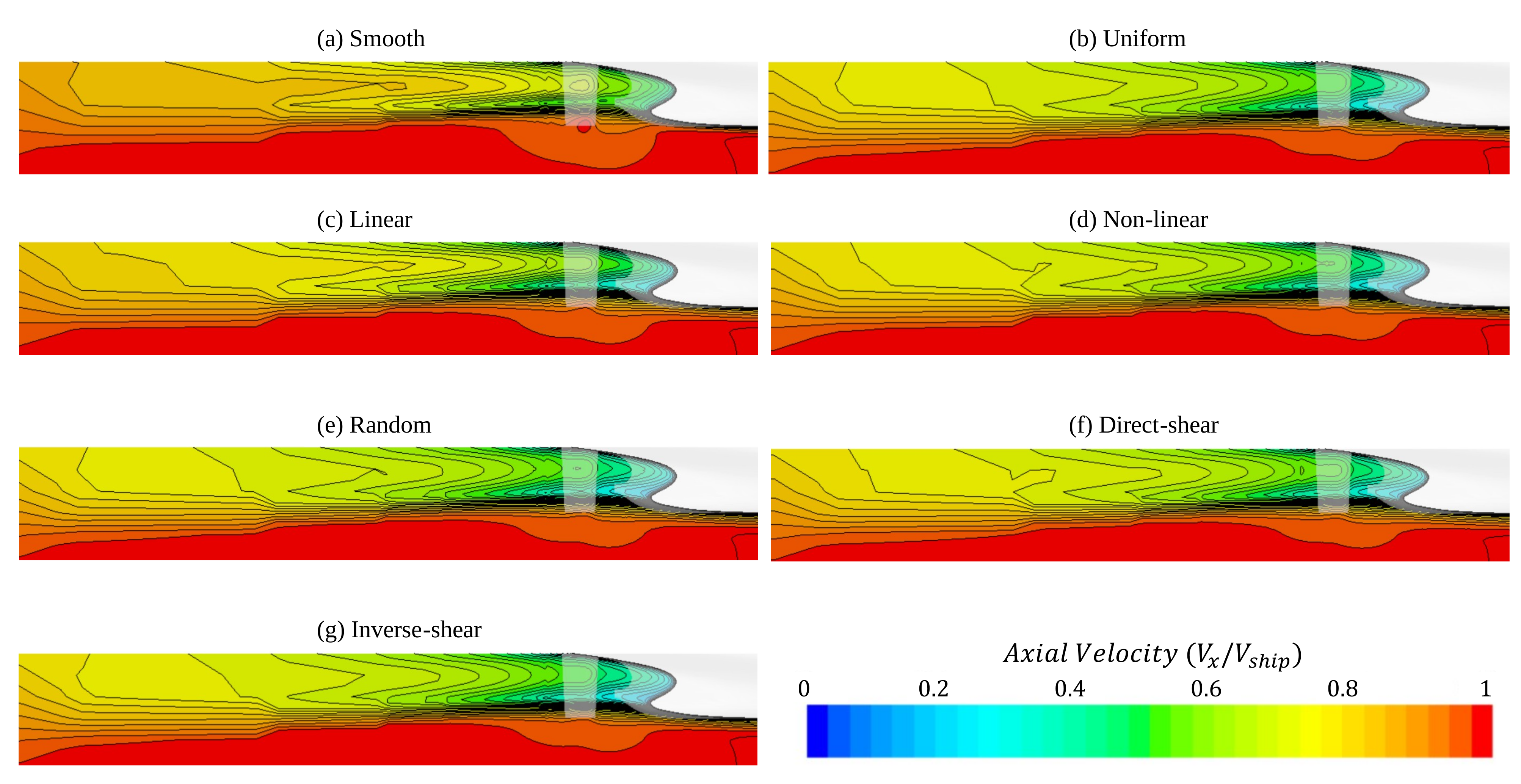
Axial velocity contours around the KCS hull under smooth and spatially varying roughness conditions
Figure 3. Axial velocity contours (Vx/Vship) around the KCS hull, extracted at y = 0.006Lpp, comparing the smooth hull and spatial roughness distributions with the same arithmetic mean roughness height under the B20% condition.
The axial velocity contours show that the spatial distribution of hull roughness alters boundary-layer development and modifies the wake structure. Longitudinally varying roughness patterns produce noticeable changes in boundary-layer growth and wake-deficit formation, whereas the uniform and shear-based configurations produce comparatively milder effects. These flow-field modifications underpin the resistance variations observed in the preceding analysis and highlight the hydrodynamic sensitivity to roughness spatiality.