Resistance and speed penalty of a naval ship with hull roughness
Ocean Engineering (2024)
Woo-seok Choi 1,
Gyeong-seo Min 1,
Sang-seok Han1,
Hae-chan Yun 1,
Momchil Terziev 2,
Saishuai Dai 2,
Daejeong Kim 3,
Soonseok Song 1*
1
Department of Naval Architecture & Ocean Engineering, Inha University, Republic of Korea
2
Department of Naval Architecture, Ocean and Marine Engineering, University of Strathclyde, the United Kingdom
3
Division of Navigation Convergence Studies, Korea Maritime & Ocean University, Republic of Korea
Abstract
Hull roughness, attributed to factors such as corrosion, the degradation of marine coatings, and, notably,
biofouling colonisation, leads to increased fuel consumption, thus entailing significant environmental and
economic penalties. While this issue on commercial ships is well documented in recent studies, the specific
impact on the speed of warships has received limited attention.
To fill this gap, this research quantifies the
resistance and power penalties, as well as the speed reduction under various fouling scenarios, and explores
the resultant changes in flow characteristics around the hull. For this purpose, full-scale simulations of a
naval ship, specifically the DTMB 5415, utilise the unsteady Reynolds Averaged Navier-Stokes (URANS)
method. A modified wall function model was incorporated into the numerical model to accurately simulate
the effects of surface roughness.
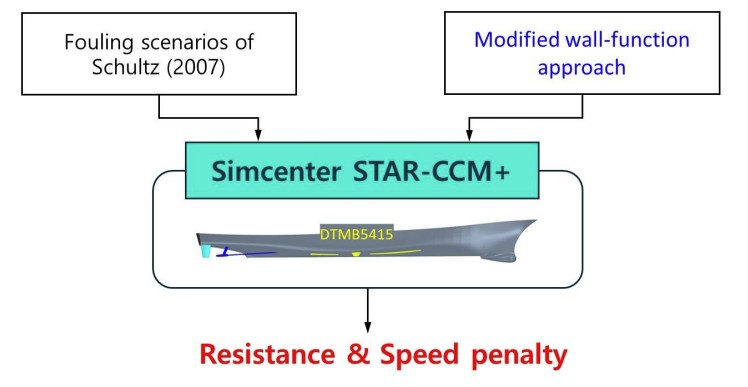
Figure 1. Diagram illustrating the flow of research.
This graphical abstract summarises the numerical framework used to quantify resistance,
power, and speed penalties induced by hull roughness under various fouling conditions.
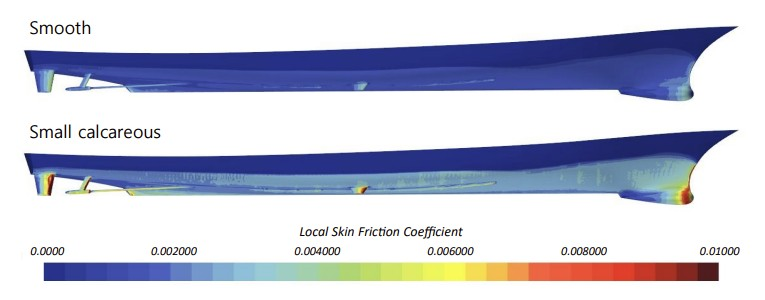
Figure 2. Distribution of local skin friction coefficient for smooth and small calcareous
fouling conditions.
The presence of small calcareous fouling leads to a pronounced increase in the local skin friction coefficient
over the hull surface. This behaviour highlights the critical role of roughness-induced turbulence in driving
resistance penalties.
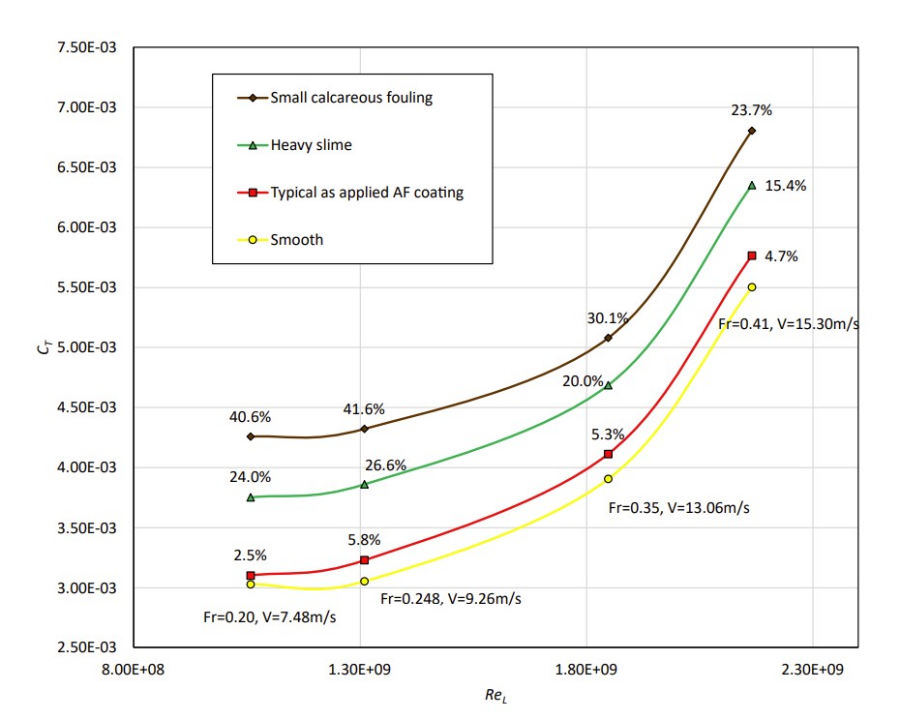
Figure 3. Total resistance coefficient of DTMB 5415 with different hull conditions at
full-scale.
Hull fouling leads to a systematic increase in resistance, with heavier fouling exhibiting progressively larger
penalties compared to the smooth hull.